
A Sustainable Economy For A Lasting Prosperity
Today I want to talk to you about my transformative vision for our economy — one that moves us from a relentless pursuit of growth alone to a...
3 min read
Mark Scheffler
:
Updated on March 11, 2026
For more than a century, the United States has taxed income — the wages we earn, the savings we build, and the investments we make. But the modern economy no longer runs primarily on paper paychecks and physical commerce. Today’s economy runs on digital financial transactions moving at lightning speed through electronic networks. It's a bridge to the future, and we've got a front row seat.
Every day, trillions of dollars move through the American financial system — through banks, stock markets, payment networks, and settlement systems. Yet almost none of that activity is taxed directly.
Meanwhile, working families spend countless hours filing complicated tax returns.
There is a better way.
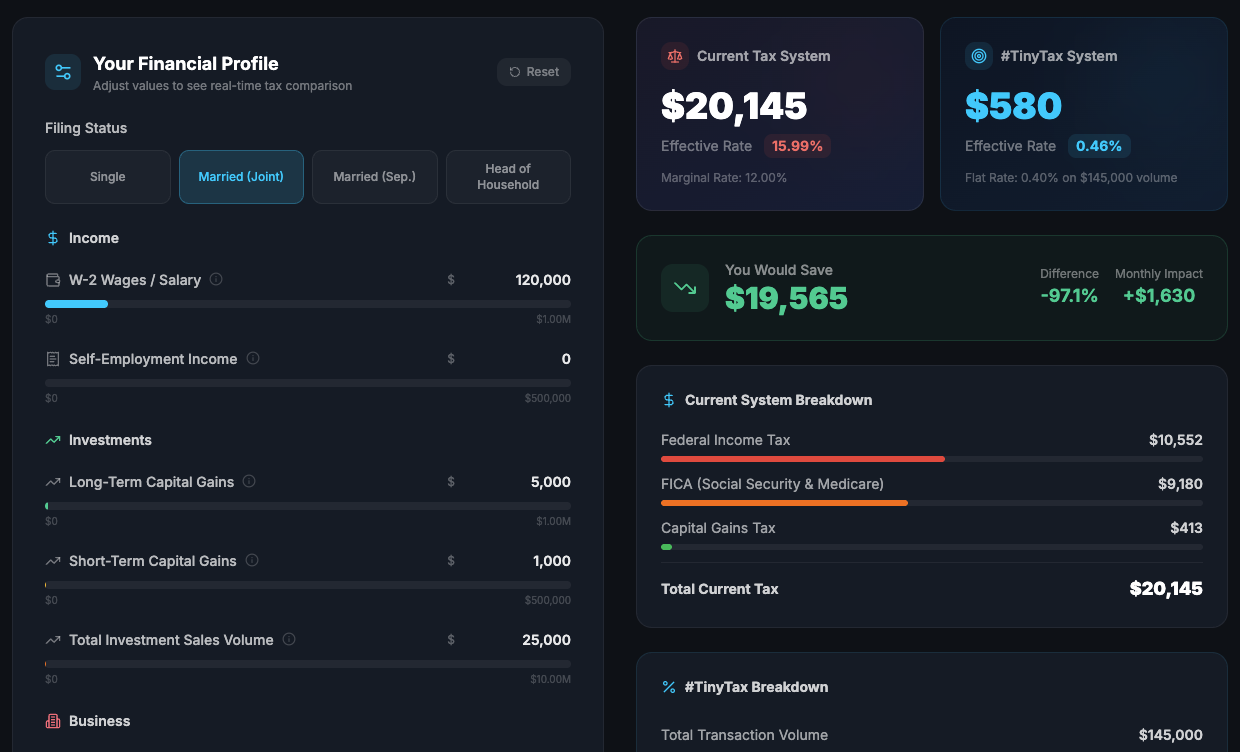
The #TinyTax proposes replacing much of our complex tax code with a microscopic tax on financial transactions — a tax so small that most Americans would hardly notice it, yet powerful enough to generate the revenue needed to run the federal government.
The goal is simple:
The United States currently operates one of the most complicated tax systems in the world.
And Americans collectively spend enormous resources complying with it.
Time Spent Preparing Taxes:
≅6 Billion Hours
Professional Tax Prep:
≅$60 Billion
Business Tax Compliance:
≅$200 Billion
Software and Accounting Services:
≅$100 Billion
That’s hundreds of billions of dollars spent simply figuring out how much tax we owe.
Even worse, the system is riddled with loopholes that reward those who can afford armies of accountants and lawyers.
Meanwhile, the people who simply earn a paycheck often carry the greatest burden.
Instead of taxing income through thousands of pages of tax code, the Tiny Tax would apply a microscopic tax to all financial transactions that take place in theU.S. economy.
Every time money moves through the financial system — whether through a bank transfer, stock trade, or electronic payment — a tiny fraction of that transaction would be automatically collected.
| Transaction | #TinyTax Paid by Receiver (0.4%) |
|---|---|
|
$10 Transaction |
4¢ |
|
$100 Transaction |
40¢ |
|
$1000 Transaction |
$4 |
|
$10,000 Transaction |
$40 |
For everyday Americans, the cost would be minimal. But across the massive scale of the U.S. financial system, that tiny rate adds up. And the rules are simple, fair, and efficient:
Modern financial markets process enormous volumes of transactions every year. Estimates suggest that $3 to $5 quadrillion moves through the U.S. financial system annually.
Even a tiny fraction of that volume generates enormous revenue.
For perspective, total federal revenue today is about $4.5 trillion annually.
The #TinyTax works because it is automatic.
Rather than asking millions of Americans to calculate their taxes each year, the tax would be collected directly by the financial infrastructure that already processes transactions.
Collection could occur through:
In other words:
No filing required. No paperwork. No audits for ordinary Americans. April 15th becomes just another beautiful day.
Because the tax is based on financial activity, it naturally scales with the size of transactions.
The biggest contributors would be entities that move enormous amounts of money through financial markets.
These include:
Meanwhile, ordinary Americans who primarily earn wages would see far lower tax burdens. This effectively shifts taxation away from labor and toward the movement of money through the digital economy.
A #TinyTax on Wall Street could replace massive taxes on Main Street.
Today, millions of Americans spend weeks every year dealing with taxes. But under the #TinyTax system, most Americans would never file a tax return again. That means no longer purchasing tax preparation software, hiring tax preparers, navigating complex deductions, and never again filing IRS paperwork. That represents an enormous financial and psychological relief.
Because the tax generates trillions in revenue, it could support major national priorities.
Mark is proposing CitizenCare CORE™, a universal primary healthcare program for every American from birth through medicare age (currently 65). It would be focused on:
Protect retirement security for millions of Americans.
Reduce student debt, offer property tax relief, and expand workforce training
Invest in construction and housing access, especially for younger Americans, veterans and the unhoused
Support clean energy development and agricultural innovation.
Restore fiscal responsibility by paying down long-term debt
The #TinyTax represents a bold modernization of the American tax system. It replaces complexity with simplicity. It shifts the burden away from working families. And it captures revenue from the enormous financial activity that drives the modern economy.
A #TinyTax. A massive simplification. And a modern tax system powering the American ecoomy.
Today I want to talk to you about my transformative vision for our economy — one that moves us from a relentless pursuit of growth alone to a...
Environmental sustainability means safeguarding the natural beauty and resources of this District, of our nation, and of the world. From our rivers...
In a healthy republic, a sustainable society means more than just civility—it means protecting the democratic institutions that make our country...